

At some point one of the incumbents you are disrupting will add a feature that copies your product. The scary part is when they copy you and price it 5x cheaper. It’s easy to panic and start discounting but doing so never ends well.
The real moat against a cheap incumbent copycat isn’t just price and feature parity; it’s a combination of usage habits, proven value, additional hooks into painful adjacent workflows and flipping the loss-leader logic.
Here’s how:
Segment your customers to identify your risk
Polish your ROI story
Flip the loss-leader logic with an 80% copycat of your competitor
Run a targeted customer success motion
Segment your customers to identify your risk
Use a simple 2x2 where each quadrant represents a distinct customer type based on how much they use your product and how sensitive they are to price:
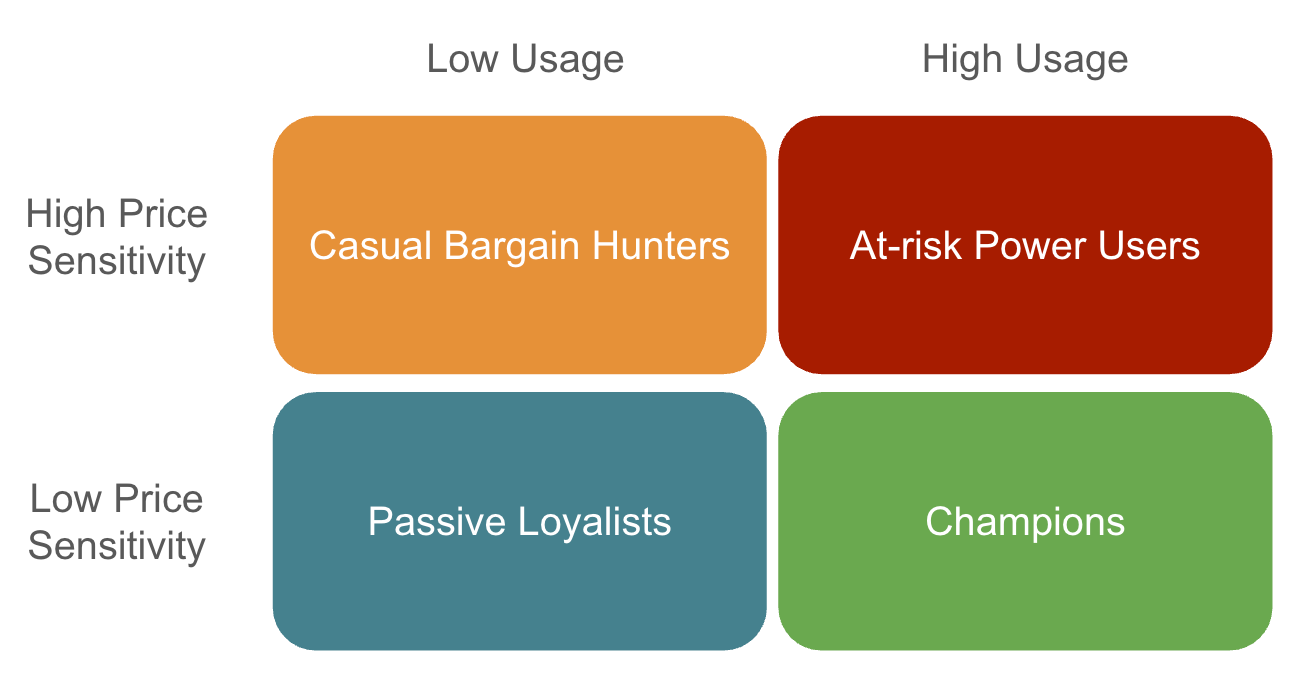
Choose the most applicable of the following options to define your high/low break points for usage:
70%+ of licensed seats provisioned and used
Consuming 60%+ of plan tier usage limit
Adopted 60%+ of key features
Choose one or more of the following to define high/low break points for price sensitivity:
Has (or has requested) a discount
Is on a month-to-month contract if your standard is annual
Bottom quartile of ACV
Polish your ROI story
Document the core value drivers of your product and the ROI you’ve driven to date. Common examples are:
Incremental revenue generated (jobs done x revenue generated per job)
Total time saved (jobs done x time saved per job)
Qualitative feedback from your most active users. Set up 1:1s with them and ask, “How has your day-to-day changed since you started using [product]?”
More on this topic here:
